The 3towers Observatory:
The History of a Modest
Suburban Observatory |
| by Tim Hunter |
IV. The 3towers Observatory:
imaging with the Apogee KX260
CCD camera |
In June 1998, I purchased a KX260 CCD camera from Apogee. This
camera has a Kodak 20 micron pixel 14-bit KX260 512 x 512 chip.
It was a pure joy to use, because it read out in one second! It
was possible to locate or center an object and focus the camera
all in "real-time." The camera was controlled by MaxIm DL/CCD
from Cyanogen. It
was used extensively for imaging the Messier objects, Arp
galaxies, comets, and a variety of NGC and IC objects. Most
imaging was performed using an f/6.3 focal reducer with the
12-inch telescope. The focal reducer telescope combination gave
an approximate system f/ratio of 6.5 with an effective focal
length of 80 inches (~ 2000mm).
Selected KX260 CCD Images: |
 |
 |
 |
 |
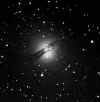
| NGC5128 |
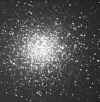
Omega Centauri. |
m17 |
m102 |
 |
 |
 |
 |
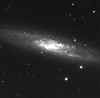
| ngc253 |
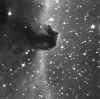
The Horsehead Nebula |
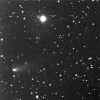
Comet Jager |
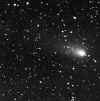
Comet Giacobini-Zinner |
| The images of Omega Centauri (NGC5139) and NGC5128 were obtained
between 5:30 and 6:00 am on 17 January 1999 as each object
culminated low on the southern horizon just above my house and
the lights of Tucson. The image of NGC5128 consists of nine
90-second exposures added together.
The image of Omega Centauri
consists of five 15-second exposures added together. The LX-200
telescope computer controls would not move the telescope to
Omega Centauri, because the object low position on the
southern horizon triggered the limit switch on the telescope
designed to prevent the telescope optical tube from striking
the base of the telescope mount. Fortunately, Omega Centauri was
visible through the telescope finder, and the telescope was
manually centered on the object for CCD imaging. These images
were purposely obtained in the early morning, because the light
pollution from Tucson is less than in the evening, and the sky
is steadier. The observatory sits approximately 6 miles directly
north of the center of Tucson. |
| Previoius Page |Next Page |
| Back to top |






